Predicting Response to Immunotherapy: Assessing  the Tumor Micro-Environment to Achieve Better Predictive Value than PD-L1 and TMB

Key Takeaways

  • DetermaIO is a novel tumor microenvironment classifier that measures expression levels of 27 genes and predicts response to immune checkpoint inhibitor therapies in multiple cancer types.
  • Two separate validation studies have shown the association with response to checkpoint inhibitor therapy in non-small cell lung cancer (NSCLC) and triple negative breast cancer (TNBC).
  • More than half of eligible cancer patients put on immune therapy every year do not respond.

In Case you Missed our Live Webinar

Featuring Dr. Naoto Ueno of the MD Anderson Cancer Center

We discussed exciting data from MD Anderson and how DetermaIO utilizes the Tumor Micro-Environment to achieve better predictive value than PD-L1 and TMB.

Click HERE for the Recording or click the button on the Right.

Key summary points:

  • There is a clear need for better biomarkers to identify patients who are likely to benefit from immune checkpoint inhibitor therapies.
  • The DetermaIO test is a 27-gene expression signature that measures three distinct facets of the tumor and its immune micro-environment to determine sensitivity and/or resistance to IO therapies.
  • Data presented in non-small cell lung cancer showed that DetermaIO was a better predictor of response than PD-L1 expression and TMB. A similar study by MD Anderson and Yale, presented at the 2020 ASCO Annual Meeting, showed better predictive ability than PD-L1 in triple-negative breast cancer.
  • DetermaIO is currently available as an RUO assay. Additional clinical trials and validation studies are planned or underway to explore the clinical utility of DetermaIO across multiple cancer types. 

Up to 750,000 patients may be eligible for immunotherapy each year, yet today more than half of patients treated with immunotherapy won’t respond. There continues to be a critical unmet need for a predictive biomarker that can identify responders and non-responders at diagnosis.

DetermaIO is a novel test that measures expression of 27 genes from the tumor microenvironment and uses a proprietary algorithm to predict response to immunotherapies. 

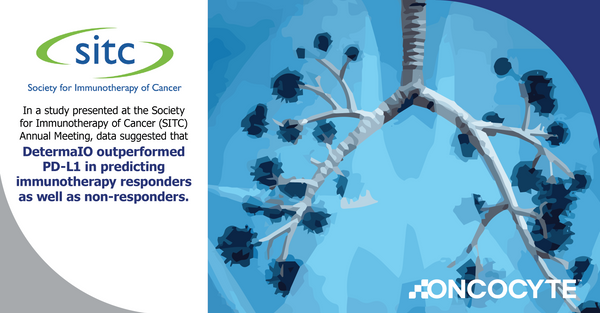
In this webinar, we presented results from two studies showing the association of DetermaIO with response to checkpoint inhibitor therapy in non-small cell lung cancer (NSCLC) and triple negative breast cancer (TNBC). Both studies suggest that DetermaIO outperformed PD-L1 and/or TMB in predicting immunotherapy response. The studies were led by multiple leading academic institutions, including the University of Texas MD Anderson Cancer Center, Yale University, the Baylor College of Medicine, and the University of Tennessee Health Science Center.

Dr. Naoto Ueno discussed results from an MD Anderson/Yale study that were presented at this year’s virtual ASCO meeting in TNBC.

Dr. Doug Ross discussed previously reported results in NSCLC that showed DetermaIO’s improved ability to predict response to immunotherapies over current leading biomarkers (PD-L1 expression & TMB).

Click HERE for the Recording

Triple Negative Breast Cancer/Immunotherapy in TNBC:

  • Triple Negative Breast Cancer accounts for 15-20% of all breast cancer cases and is defined by the absence of three common genetic markers: Estrogen Receptor (ER), Progesteron Receptor (PR), and HER2.
  • TNBC tumors tend to be more aggressive with poorer prognosis than other breast cancer tumors, and few options for targeted therapy exist for this patient population.
  • At present, a single immunotherapy has been approved for metastatic PD-L1+ TNBC, however a number of other IO drugs are being studied in a number of different clinical trials to offer additional therapeutic options for TNBC patients


Key Takeaways

  • DetermaIO is a novel tumor microenvironment classifier that measures expression levels of 27 genes and predicts response to immune checkpoint inhibitor therapies in multiple cancer types.
  • Two separate validation studies have shown the association with response to checkpoint inhibitor therapy in non-small cell lung cancer (NSCLC) and triple negative breast cancer (TNBC).
  • More than half of eligible cancer patients put on immune therapy every year do not respond.

Media Gallery

Files

Related Bios

Naoto Ueno, MD, PhD, FACP
Professor of Medicine, Breast Medical Oncology @MD Anderson Cancer Center
Ueno is a tenured professor in the Breast Medical Oncology Department, MD Anderson Cancer Center, Executive Director, Morgan Welch Inflammatory Breast Cancer Program and Clinic, and Section Chief of Translational Breast Cancer Research in the Breast Medical Oncology department. His disease focuses on inflammatory breast cancer, triple-negative breast cancer, and metastatic breast cancer, having over six ongoing investigator-initiated clinical trials for patients with IBC, TNBC, and bone metastasis. He supervises medical and graduate students, postdoctoral fellows, junior faculty, and clinical residents and fellows, resulting in their successes in both academia and industry. Ueno received The University of Texas System Regents' Outstanding Teaching Award for his contributions in 2014 and the Nylene Eckles Distinguished Professorship of Breast Cancer Research in 2012.
View Full Bio>>
Doug Ross, M.D., Ph.D.
Chief Medical Officer
Prior to joining Oncocyte, Dr. Doug Ross was a founding principal in the Bethesda Group, LLC, a boutique consulting firm that provided technical, commercial and operational expertise to the diagnostic and pharma industry. He is an experienced medical diagnostics R&D executive with a background in research and development at the intersections between genomics, proteomics and diagnostics. He co-founded a successful genomics-based diagnostic business, served in executive leadership positions in CLIA reference laboratories, and managed proprietary content through research, development and launch.

Doug’s private sector career started in 2000 as Chief Scientific Officer of Applied Genomics, Inc. (AGI), a company he co-founded coming out of post-doctoral training at Stanford University. AGI translated insights from gene expression patterns into immunohistochemistry multivariate assays targeted to actionable clinical problems.

In 2009, Clarient, Inc., a leading national pathology reference laboratory, acquired AGI. Doug continued his role as Chief Scientific Officer and launched two proprietary products. General Electric Healthcare acquired Clarient in December 2010, and Doug continued as CSO and worked closely with the business development and partnership teams at Clarient and capital teams at GE Healthcare.

In 2011 Doug joined the Medical Science Division of Life Technologies as CSO on a consulting basis until the acquisition of Life Tech by Thermo Fisher Scientific in 2013. He was CSO of CardioDx, Inc. from April to December of 2014. In September 2015, Doug became a founding principal in Bethesda Group, LLC.

Doug obtained his M.D. and his Ph.D. in Pathology from the University of Washington while studying at the Fred Hutchinson Cancer Research Center in Seattle, WA. He completed two years of Clinical Pathology training including serving as Chief Resident at the University of California at San Francisco before joining the genomics project as a post-doc with Patrick Brown at Stanford University in 1996.
View Full Bio>>
Ronald Andrews
President and CEO
Ronnie Andrews joined Oncocyte as Chief Executive Officer in July 2019. Before joining Oncocyte, Ronnie was the founder and principal of the Bethesda Group LLC; a boutique consulting group focused on helping small and mid-stage diagnostic companies and investment groups move emerging diagnostic content and platforms into the marketplace.

Ronnie has close to 30 years of experience in the US Clinical and Molecular Diagnostics industry. He served as the President of the Genetic Science Division for Thermo Fisher Scientific until December 2014. In this role, Ronnie oversaw the integration of Life Technologies’ genetic platforms, including Life’s chip-based Next Generation Sequencing Technology, Ion Torrent.

Before this, Ronnie held several other high-profile executive roles, including President of the Medical Sciences Venture within the Life Technologies Corporation, and he served as Chief Executive Officer of Clarient, a public company on the NASDAQ, which was sold to General Electric Healthcare in December 2010.

Ronnie is a passionate ambassador for the need for democratization of information into community-based environments to better manage deadly diseases like cancer, as well as control healthcare costs by keeping the patient and treatment close to home. He regularly speaks to industry groups and was selected as the Regional Winner for Ernst & Young’s Entrepreneur of the Year in 2011.
View Full Bio>>
Mitch Levine
Chief Financial Officer
Mitch Levine joined Oncocyte as Chief Financial Officer in November 2017. Before joining Oncocyte, Mr. Levine was the Managing Partner of Kirby Cove Capital Advisors, which provides consulting services to international life sciences investment funds regarding collaboration and investment in US-based life sciences companies.

In 2002, Mr. Levine founded Enable Capital Management and grew the firm into one of the largest and most respected brands globally in alternative finance. Its flagship fund, Enable Growth Partners, provided growth capital to more than 500 private and publicly traded companies, catalyzing transformative corporate innovation, job growth, and economic expansion in technology, life sciences, consumer products, and energy.

Before founding Enable, Mr. Levine was a founding member of The Shemano Group, a leading San Francisco-based investment bank that focused on the capital needs of growth companies.

He has also worked at Bear Stearns and Lehman Brothers. Mr. Levine received his BA from the University of California, Davis.
View Full Bio>>
Padma Sundar
Chief Commercial Officer
Padma Sundar has extensive experience in launching oncology tests for global diagnostics companies, helping them achieve market leadership positions.

Before joining Oncocyte, Ms. Sundar served as Vice President of Strategy and Market Access at CellMax Life, where she launched the first blood test for preventative colon cancer screening. Before CellMax, she was a Director of Marketing at Guardant Health, where she drove a 75% increase in test volume and adoption by U.S. oncologists.

As a Senior Director at Roche Sequencing, she launched the first next-generation sequencing (NGS) liquid biopsy kit for cancer recurrence monitoring. She was also Senior Director for the oncology portfolio at Affymetrix, where she brought the first whole-genome microarray kits “OncoScan” and “CytoScan” for solid and liquid tumor profiling to 50 leading academic and reference labs worldwide.

Ms. Sundar began her career at McKinsey and Company. She received her M.B.A. and M.P.H. from the University of California, Berkeley, and her B.A. in Chemistry from the University of Delhi.
View Full Bio>>

Contacts

Oncocyte Marketing
ocxmarketing@oncocyte.com